AI is not coming.
It is already part of how businesses work.
It can help us brainstorm, test ideas, explore data, challenge assumptions and work through different strategies.
It can make research faster, surface patterns we may have missed and help us approach problems from different angles.
Used properly, it can make good professionals more efficient and more effective.
But it is still a tool.
And tools do not carry responsibility.
A calculator did not make the accountant redundant.
Spreadsheets did not make professional judgement unnecessary.
Accounting software did not remove the need to understand the transaction.
AI is no different.
It can support the work, improve efficiency and help us reach better-informed conclusions.
But it does not replace judgement.
It does not understand responsibility in the way a human does.
And it does not carry the consequences when the answer is wrong.
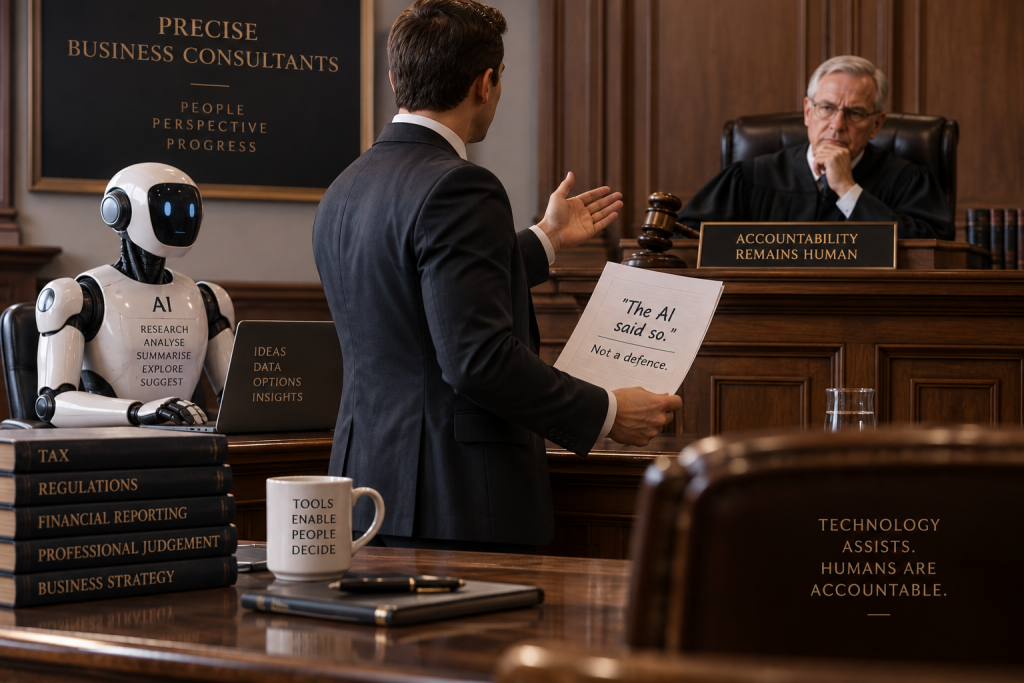
If an AI system produces the wrong tax treatment, an incorrect legal interpretation, a flawed financial model or a misleading conclusion, the response cannot simply be:
“The AI said so.”
A court, regulator, client, shareholder or SARS will ultimately look to the person or professional who relied on that output.
The underlying responsibility remains human.
That means AI output still needs to be challenged, checked and understood.
The question is not whether AI should be used.
It should.
The better question is whether it is being used as a tool to improve human judgement — or as a substitute for it.
Previous technological innovations improved efficiency without changing the underlying responsibility for the quality of the work.
AI is no different in that respect.
The technology may be new.
The principle is not.
You remain accountable for the answer — at least for now.
Using AI Without Losing Accountability
AI can create enormous efficiencies when it is used properly.
The value lies in combining technology with experience, judgement and proper review.
Precise Business Consultants uses technology to improve efficiency and insight without compromising the professional responsibility behind the work.