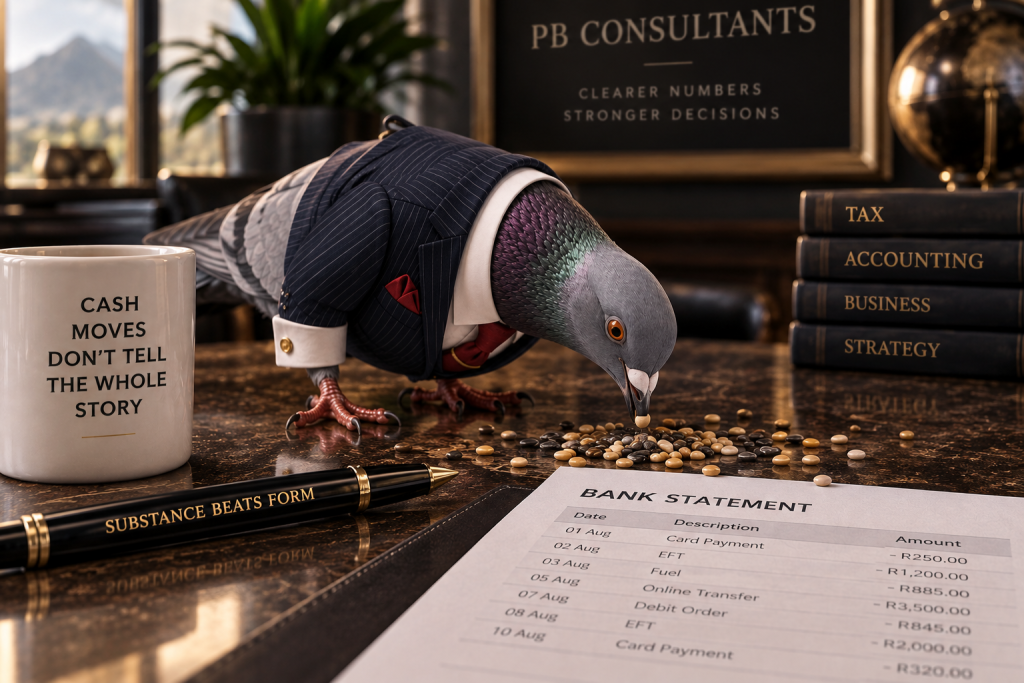
Preparing accounts from a bank statement alone is the accounting equivalent of pigeon bookkeeping: lots of pecking at transactions, but very little understanding of what sits behind them.
A bank statement is a record of cash flow.
It shows that money was received or paid.
That is important.
But it does not, on its own, prove the nature of the transaction.
A R20,000 payment confirms that R20,000 left the bank account. It does not confirm that the amount was:
- a valid business expense,
- tax deductible,
- subject to VAT,
- correctly classified,
- or even incurred for business purposes.
That requires supporting documentation.
An invoice, agreement, receipt or other source document explains what the payment was actually for. The bank statement supports that the payment took place.
The reverse is also important.
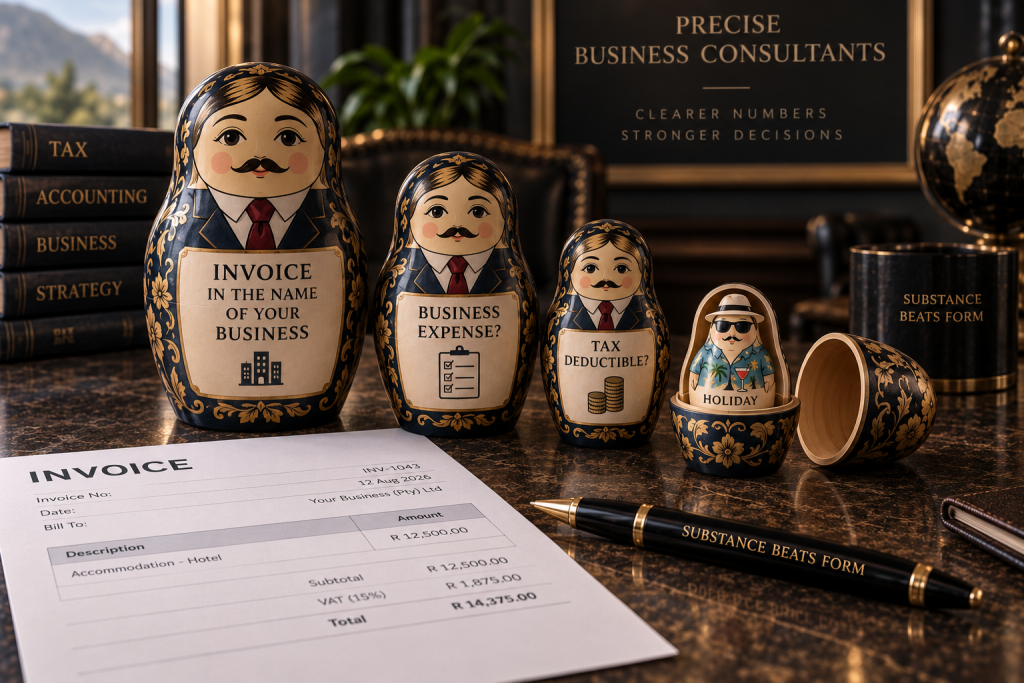
An invoice alone does not necessarily prove that a genuine transaction occurred. This is why SARS will often request both the supporting invoice and proof of payment during a verification or audit.
The invoice helps establish the nature of the transaction.
The bank statement helps establish that the payment actually took place.
Together, they provide far stronger evidence than either document on its own.
The same applies to money received. A deposit could be revenue, a shareholder loan, capital introduced, an inter-account transfer or the proceeds from the sale of an asset.
The bank statement cannot tell you which.
Bank statements represent cash flow, and cash flow is an important part of the accounting records.
But cash flow only tells us that money moved.
It does not tell us the substance of the transaction, whether the transaction is valid, how it should be classified or what its tax treatment should be.
That requires supporting documentation and professional judgement.
A bank statement can support that a payment was made.
It cannot, on its own, prove what the payment was for.
That distinction is part of the difference between producing a set of numbers and producing accounting records that can actually be relied upon.
Are Your Accounts Built to Stand Up to Scrutiny?
If your accounting is being prepared primarily from bank statements, it may be worth asking what sits behind those numbers.
Quality accounting should leave you with records that are properly supported, correctly classified and capable of standing up to SARS, an audit, due diligence or simply good management decision-making.
Book a Strategy Consultation with Precise Business Consultants to review the quality of your accounting records, tax position and supporting documentation.